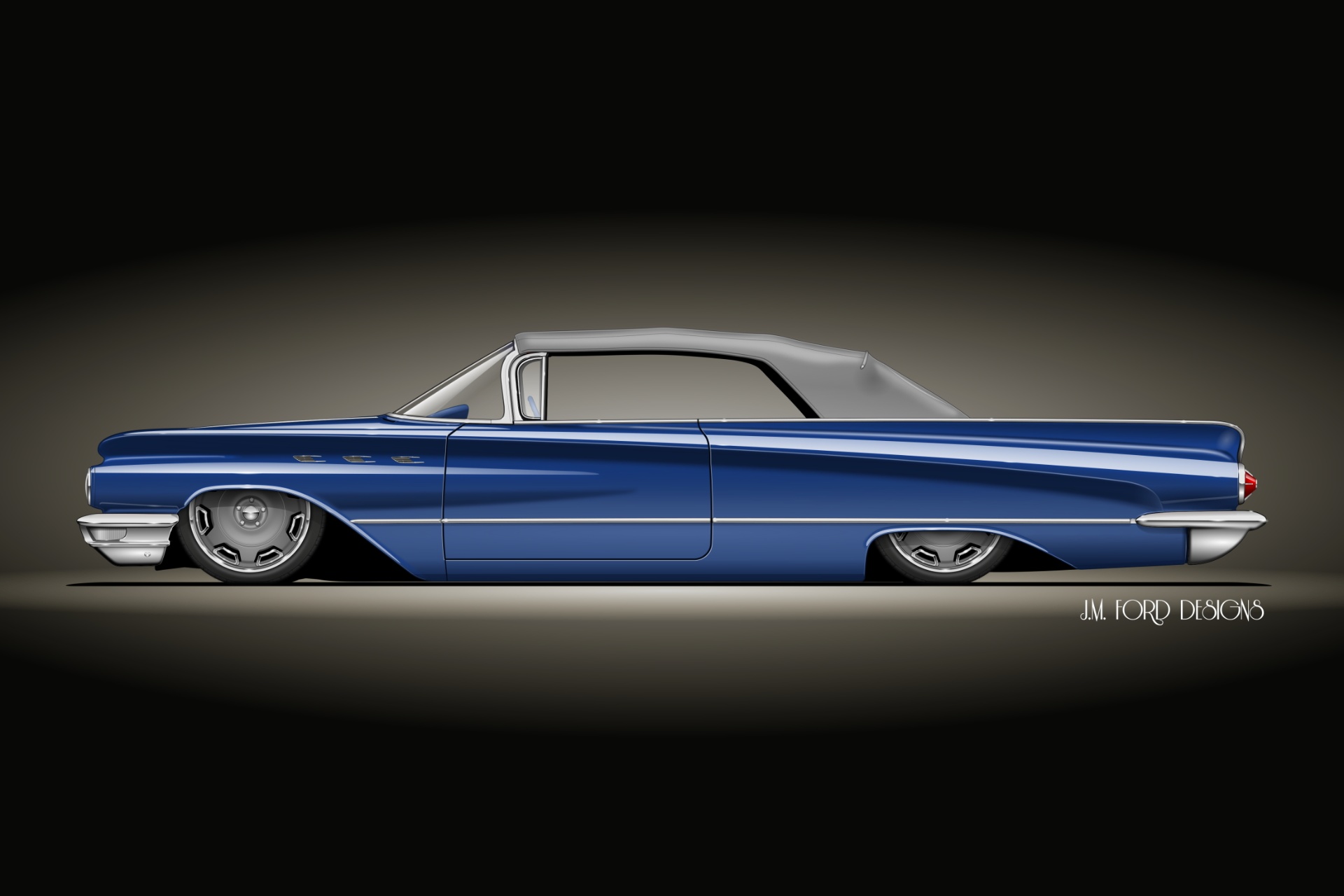
This guide covers the Hammer Fab Street Connection suspension system for 1959–1960 Buicks. Everything here comes from our own development work — 3D scanning, CAD, fixture-built parts, and real fitment testing on an actual 1959 Buick LeSabre convertible — and from the current option list on the product page. Where a number or a compatibility question has not been verified by us, it is not in this guide.
Modernizing a 1959–1960 Buick
These cars are long, heavy, and were never designed around 20- and 22-inch wheels, modern brake packages, or an LS drivetrain. The work is mostly a packaging problem: getting correct suspension geometry with a big wheel under the fender, integrating air springs into structure that was never built for them, and fitting a modern engine and transmission around the factory steering.
Rather than assembling unrelated aftermarket parts, the Street Connection Buick system was designed as one package using 3D scanning and CAD, then fixture-built so installation repeats car to car. It keeps modification to the car intentional and minimal: no firewall or transmission tunnel cutting is required, and the only sheet-metal work is a small, templated floor modification under the rear seat.
Front suspension
Control arms
The front uses modified upper and lower control arms with heavy-duty ball joint cups, fixture-built and TIG welded. A core is required — you send acceptable factory arms back and the core charge is refunded on receipt. Multiple acceptable core sets may be returned. Hammer Fab upper ball joint plates and lower cups, plus Moog ball joints, complete the assembly.
Spindles and steering
Wilwood Pro spindles are used up front. The standard bolt pattern is 5x4.75", front and rear, unless otherwise specified after checkout. 5x5" is the factory Buick pattern and can be arranged — tell us before we build your order.
The front hub bore is 3.125" diameter with a 0.75" protrusion from the mounting face. Wheel center bore must clear this register for proper fit and load carrying.
The system keeps the factory Saginaw steering box, drag link, and tie rods. The steering upgrade adds CNC-machined tie rod sleeves designed specifically for 1959–1960 Buicks, integrated dropped steering adapters, and 3/4" heim joints for articulation with less bind. No steering component core is required.
Air springs
The front rides on SS7 air springs with mounting hardware and swivel fittings, TIG-welded upper and lower air bag plates with cups and risers, and weld-on upper shock brackets. KYB shocks are included front and rear, with single-adjustable RideTech (FOX) shocks available as an upgrade. Extended bump stops with weld-in T-nuts help prevent shock overextension.
Front sway bar
A 1-1/4" solid splined sway bar with arms and links is part of the front system, along with bolt-on laser-cut, CNC-bent reinforcement brackets and the hole saw and hardware needed to install them.
Brake options
Brakes are configured separately from the base kit. The current option is a Baer big brake kit — 14"+ Pro 6-piston, satin black calipers with gloss black lettering — available front and rear, front only, or rear only. The front-and-rear package includes the billet Baer ReMaster master cylinder; the ReMaster can also be added on its own.
Rear suspension
Triangulated four-link
The rear is an adjustable triangulated four-link with rubber bushings and a pre-set pinion angle, built around a tube-laser-cut crossmember that integrates body mounts, four-link tabs, exhaust clearance, and a carrier bearing mount. Also included: fixture-built, TIG-welded axle brackets, weld-on upper four-link brackets, a rear crossmember reinforcement plate that doubles as a cutting template, and a pumpkin bump in the crossmember for extra differential clearance.
Air springs and shocks
The rear uses SS8 air springs with mounting hardware, upper air bag mounts that can be bolted or welded in, and bolt-on upper shock mounts.
Ford 9-inch rear
A TIG-welded Ford 9" housing carries dual-pattern axles in 5x4.75" and 5x5", so the rear bolt pattern matches whichever front pattern you configure — 5x4.75" is standard. Front and rear hub bore are the same 3.125" diameter; the rear axle register protrudes 0.25" from the mounting face. Third members are a separate selection: Detroit Speed 8.8 units in 3.31, 3.55, 3.73, or 4.10, or Moser 9" Tru Trac units in 3.25, 3.50, 3.70, 3.89, or 4.11. Gearing should be chosen against engine, transmission, tire diameter, and how the car will actually be driven.
Wheel and tire fitment
Wheels and tires are not included. The system is optimized around a 20-inch front and 22-inch rear combination, with 60.5" track width front and rear.
Confirmed front fitment
- 20 x 9 wheel
- 4.25" backspacing
- 255/40R20 tire
- 60.5" front track width
- 3.125" hub bore with 0.75" register protrusion
Confirmed rear fitment
- 22 x 10 wheel
- 5.75" backspacing
- 275/40R22 tire
- 60.5" rear track width
- 3.125" axle center bore with 0.25" register protrusion
These are the fitments Hammer Fab runs in development — the same 20x9 front and 22x10 rear package ordered for the white 1959 Buick project. They are a proven starting point, not a guarantee that every wheel design in those dimensions clears every brake package — wheel spoke shape, barrel profile, and caliper choice all matter. Send us your intended wheel before ordering brakes if you are unsure.
Minimum wheel diameter for brakes
The current big-brake option is Baer brakes only, and they require a minimum 18" wheel. Factory 15" wheels will not clear the Baer package. Confirm your wheel diameter with us before you order brakes.
Air suspension: what is and isn't included
This is the single most common misunderstanding, so it is worth being blunt about it.
- Included: the air springs themselves — SS7 front, SS8 rear — with their mounting hardware, plates, cups, risers, brackets, and fittings, plus KYB shocks front and rear.
- Not included: the air management system. The compressor, tank, valves, and control components are supplied separately and are not part of the Buick suspension kits.
In other words: the kit gives you the suspension hardware and the air springs mounted into properly engineered structure. How you supply and plumb the air management side is a separate decision. Ask us if you want help matching a system.
LS engine swap
Hammer Fab engine mount kit
The swap hardware is configured on the same product page as three distinct choices:
- Full LS / 4L80E engine and transmission mount kit
- LS engine mount kit only
- 4L80E transmission mount kit only (includes the crossmember)
The transmission crossmember is sold separately from the engine mount kit. They are both add-on options — buying LS engine mounts does not get you the crossmember, and vice versa. If you want both, select the full LS / 4L80E kit.
LS swaps also require selecting the correct kit including an oil pan that provides drag-link clearance, because the factory Saginaw steering and drag link stay in the car. Factory engine mounts are removed and replaced where applicable.
Installation templates
Mount location is the part of an LS swap that people get wrong, so the kit ships with printed locating templates rather than leaving you to measure off a scanned car you don't have. Installation support includes 3D-printed guides, written instructions, and QR-linked video support.
Cooling, transmission, and driveline
- Radiator: Johnson's Radiator for LS/LT swaps, painted black, is an available option.
- Transmission: a Bowler Performance GM 4L80E package for LS engines (rated up to 650 lb-ft of torque) is available through the configurator.
- Driveshaft: a Dan's Driveline custom two-piece driveline for the 9" housing (good to 650 HP) is offered in LeSabre and Invicta configurations.
- Engine: Don Hardy LS engines with billet nailhead adapters, built ready to install — 416ci (660 HP), 454 LSX (750 HP), and 427ci 2.9 Whipple supercharged (900 HP), with black, custom Cerakote, or polished Billet Specialties accessories.
- Dress-up: Don Hardy billet nailhead valve cover / coil pack kits in raw machined or chromed finish, with valve cover finish options of chrome plating, engine-color powder coat, or Cerakote to match the accessories.
Who makes what: the K-member-side hardware — modified control arms, ball joint plates and cups, air bag plates, tie rod sleeves and dropped adapters, crossmembers, axle brackets, engine and transmission mounts, reinforcement plates — is fabricated by Hammer Fab. Baer, Wilwood, RideTech, KYB, Moog, Detroit Speed, Moser, Bowler, Johnson's, Dan's Driveline, and Don Hardy components are third-party products configured and sold through Hammer Fab. Air management, wheels, tires, exhaust, and fuel system are customer-supplied.
When you order drivetrain components, matching camshaft, torque converter, rear gearing, and tire diameter matters more than any single part choice. We will help you pick the combination.
What comes in the suspension package?
The product page is configured base kit first, options second. You choose a base kit — front, rear, or front and rear — and then add everything else on top of it.
Base kit
The base kits are the suspension hardware described above with no brakes: control arms, spindles, air springs, shocks, sway bar, brackets, crossmembers, four-link, Ford 9" housing and axles. The front base kit carries a $300 core charge, refunded when acceptable control arms are received.
Configurable add-ons
- Baer big brake kit (front and rear, front only, or rear only) and ReMaster master cylinder
- Single-adjustable RideTech (FOX) shock upgrade
- Rear third member — Detroit Speed 8.8 or Moser 9" Tru Trac, multiple ratios
- LS / 4L80E swap kit, or engine mounts and transmission crossmember individually
- Johnson's radiator, Bowler 4L80E, Dan's Driveline driveshaft
- Don Hardy LS engine packages, valve cover / coil pack kits, and finishes
If you only need add-ons, the configurator includes a "no suspension right now" base selection so parts can be ordered on their own.
What requires fabrication
- Welding: air bag plates, upper shock brackets, weld-in bump stop T-nuts, axle brackets and upper four-link brackets, and weld-in air bag mounts where that option is chosen
- Minimal rear floor modification beneath the rear seat — the required hump is included and the reinforcement plate serves as the cutting template
- Front inner fenders may require modification to achieve maximum suspension drop
- Factory engine mounts removed and replaced where applicable; templates included
- No firewall or transmission tunnel cutting is required
- A professional alignment after installation
We do not publish install-hour estimates — the work varies too much car to car. If you are not welding it yourself, line up a shop that can before the freight arrives.
Development vehicle: 1960 Buick convertible
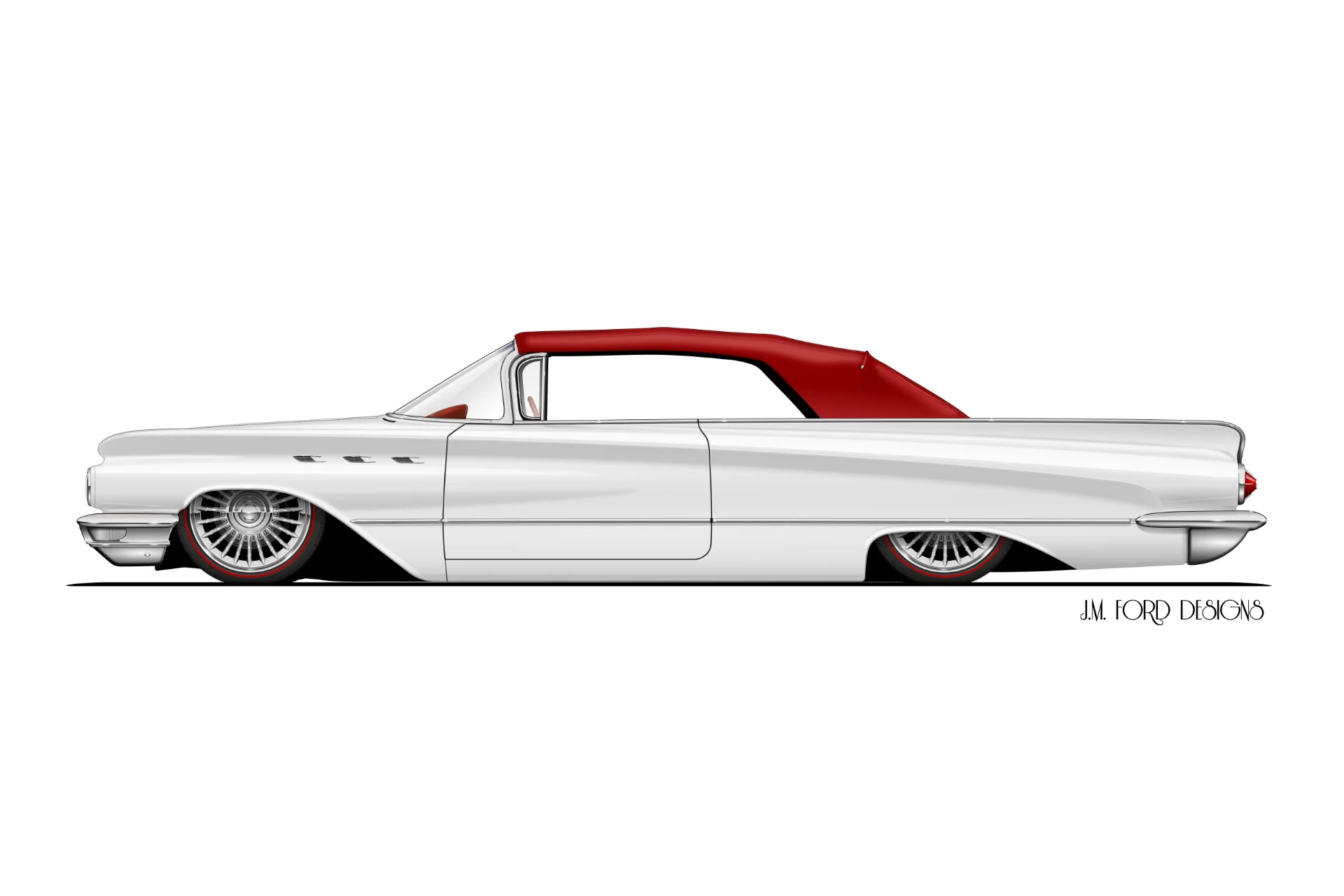
The system was designed with 3D scanning and CAD and tested on an actual 1959 Buick LeSabre convertible. Our 1960 Buick convertible concept shows the same recipe as a complete car: Street Connection chassis upgrades, air ride, LS backed by a 4L80E, a 9-inch rear, and the 20/22-inch wheel package the geometry was built around.
The scanning and CAD process behind these parts is the same workflow we teach at Hammer Fab Academy.
Before you order
- Decide your wheel package first — brake selection depends on wheel diameter and design
- Bolt pattern: 5x4.75" front and rear is standard unless otherwise specified after checkout
- Plan the air management system separately; it is not included
- For an LS swap, confirm the oil pan for drag-link clearance and whether you need the crossmember as well as the engine mounts
- Choose gearing against engine, transmission, and tire diameter
- Freight is not included in checkout. LTL freight is required and is quoted and invoiced separately after the order, based on your final configuration and destination. International orders require a manual invoice — contact us first.
- Some components ship separately or direct from the manufacturer; allow roughly 2–6 weeks for complete delivery
- Unusual combinations, non-standard wheels, or a car that has already been modified — talk to us before ordering